


In broad terms, semiconductors sit between conductors (such as copper) and insulators (such as glass). They don’t always conduct electricity, but, under the right conditions, they can. They are therefore controllable by ensuring the conditions are correct and that is what makes them the spine of modern electronics, from telephones to vehicles, military applications to healthcare technology and beyond.
What is a semiconductor?
A semiconductor is a material, usually silicon, whose electrical conductivity can be precisely controlled with the addition of impurities, voltage, or changing temperature.
The basis of their use comes from the what is known as the band theory of solids:
- Semiconductors have a small gap, meaning that electrons can move if given a little push.
- Conductors have overlapping energy bands, resulting in electrons flowing more easily.
- Insulators have a large gap, so electrons can’t flow.
What are semiconductors used for?
Semiconductors are what allow devices to:
- Switch signals on and off (binary computing)
- Process data (such as CPUs in computers)
- Amplify signals (radios and other audio uses)
Ultimately, the website you’re viewing this page on, runs on billions of microscopic semiconductor switches. They power almost every technological aspect of modern day life.
From 5G communications to Wi-Fi and satellites, they’re essential in providing the communication systems the world has come to rely on.
However, they’re hidden in vast arrays of other elements of day-to-day life. Any modern vehicle, such as a car, has transformed into a computer on wheels – powered by the capabilities of semiconductors.
The engine control unit (ECU) in your car, systems that aid car braking, electronic dashboards and much more are all reliant on semiconductors. The rise of the EV (electric vehicles) means that semiconductors are essential for purposes like battery management and self-driving features.
They pervade everything from heavy industry to energy solutions (solar panels, wind turbines, etc.), healthcare systems (MRI and CAT scanners, but even down to pacemakers), military systems from missiles to radar, your home lighting, oven – even your vacuum cleaner.
What types of semiconductors are there?
Semiconductors fall into distinct categories in respect of their type, including:
Logic semiconductors (processors)
These are the semiconductors that power computer chips, including CPUs (the main brain of a computer). You’ll find them in every mainstream device from a laptop to an Apple iPhone and far more powerful computing applications.
Memory semiconductors
These semiconductors store data, sometimes only temporarily, but also permanently. They include DRAM for short-term tasks and NAND Flash used in long-term data storage devices – like the SSD inside a computer or phone.
Analog semiconductors
Analog semiconductors deal with temperature, voltage, sound and other ‘real-world’ signals. They’re used in items such as amplifiers, voltage regulators and signal converters. You’ll commonly find them in an audio system, thousands of types of sensors and anything where power needs regulating.
Power semiconductors
These are used to convert and control electricity more efficiently. They include MOSFETs, IGBTs and diodes. Made with materials like silicon carbide and gallium nitride, they’re found in electric vehicles, renewable energy systems and power supplies, amongst others.
Discrete semiconductors
You could think of these as the building blocks of systems, responsible for single functions. They include diodes with a one-way current, basic switching transistors and rectifiers. They’re used in almost all electronic circuits.
Optoelectronic semiconductors
These convert electricity into light and including LEDs (light-emitting diodes), laser diodes and photodetectors. They’re in displays (TVs, computers, etc), fibre optic communications and sensors.
RF (radio frequency) semiconductors
Specifically designed for high-frequency signals, RF semiconductors are used in RF amplifiers and transceivers. They’re a critical component in wireless communications and are used in smartphones and Wi-Fi systems.
System-on-Chip (SoC)
These are commonly found in Apple iPhones and other smartphones, where several functions are combined in one chip. The CPU, GPU, memory and connectivity and highly integrated and efficient in their use of power.
Sensors
Camera image sensor semiconductors are a classic example of this type, along with temperature sensors and motion sensors found in gyroscopes and accelerometers. They convert physical movement/signals into electrical data.
Semiconductors summary
Semiconductors are an every-day functional device or chip in today’s world. They’re made for several purposes including thinking (logic), storage (memory), sensing (analog), electricity control (power) and communicating (RF).
Ashlea Components stock and retail many of the most popular semiconductors available, along with many for specialist purposes.
-
 £0.00
£0.00 -
#494LYF-0084K
£0.00 -

.HCNR201-000E
£1.70 -
0 272 248 021
£0.00 -
0 273 141 181
£0.00 -
0 273 141 234
£0.00 -
0 273 141 273
£0.00 -
0 273 142 062
£0.00 -
0 273 300 389
£0.00
Featured Product from Semiconductors & Integrated Circuits
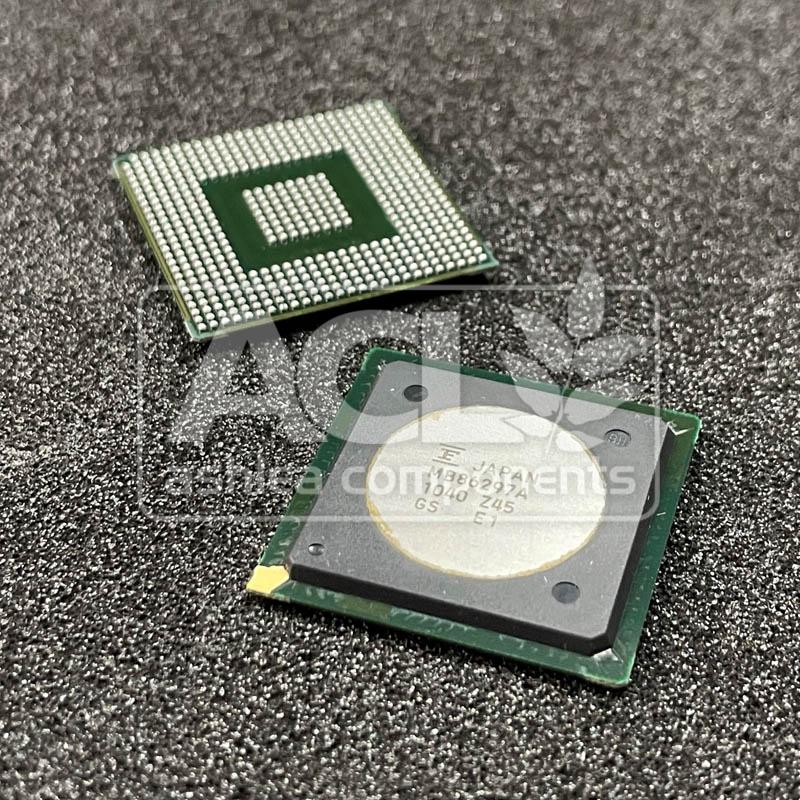
MB86297APBH-GSE1
Video Controller IC, GPIO, I²C, Serial, 543-TEBGA (27×27)


