


A resistor is an electronic component designed to oppose or limit the flow of electric current in a circuit. It is one of the most fundamental components in electronics and is used in almost every electrical and electronic device.
How does a resistor work?
Resistors work by converting some electrical energy into heat, which reduces the amount of current that can flow through a circuit.
The amount of opposition a resistor provides is called resistance, measured in ohms (Ω). The relationship between voltage, current, and resistance is described by Ohm’s Law. The law states that the current flowing through a conductor is directly proportional to the voltage applied across it and inversely proportional to its resistance.
Ohm’s Law is extremely important because it allows engineers and technicians to calculate how circuits will behave. It is used to design power supplies, choose resistor values, calculate safe currents, and troubleshoot electrical systems. Nearly all basic circuit analysis depends on this relationship.
What does an resistor do?
We can broadly define what resistors do in 5 categories:
1. Limit Current
One of the most common uses of resistors is to prevent too much current from flowing through sensitive components.
For example:
- LEDs (light-emitting diodes) almost always need a resistor to stop them from burning out.
- Microcontrollers use resistors to protect input/output pins.
2. Divide Voltage
Resistors can split voltage into smaller values using a voltage divider circuit.
Voltage divider equation:
Vout=VinR1+R2R2
This is widely used in:
- sensor circuits
- analog inputs
- signal conditioning
3. Pull-Up and Pull-Down Functions
Digital circuits use resistors to ensure inputs have a defined logic state.
These resistors prevent floating signals that could cause unpredictable behaviour.
4. Generate Heat
Some resistors are intentionally used as heating elements.
Examples:
- electric heaters
- toasters
- hair dryers
5. Control Timing and Filtering
Together with capacitors and inductors, resistors help create:
- timing circuits
- filters
- oscillators
- signal shaping networks
Types of resistors
While there are several types of resistors, we’ve summarised the main types below:
Carbon film resistors
These are cheap and common general-purpose resistors. They are made by depositing a thin layer of carbon onto a ceramic insulating rod. A spiral groove is then cut into the carbon layer to increase and precisely control the resistance value. Metal leads are attached to each end, and the resistor is coated with a protective outer layer for insulation and durability.
The resistance value of a carbon film resistor depends on the thickness and length of the carbon film. By cutting the spiral pattern deeper or longer, manufacturers can increase the resistance. These resistors are typically identified using colored bands printed on the body, which indicate the resistance value, tolerance, and sometimes temperature coefficient.
Carbon film resistors are popular because they are inexpensive, reliable, and suitable for general-purpose electronics. They offer better stability and lower noise than older carbon composition resistors, although they are generally less precise than metal film resistors. Typical tolerances are around ±5% or ±2%, making them acceptable for many everyday circuits where extremely high precision is not required.
They are widely used in consumer electronics, educational projects, hobby circuits, and basic analog or digital electronics. Applications include current limiting, voltage dividing, pull-up and pull-down resistors, and signal conditioning. Although modern electronics increasingly use surface-mount resistors, carbon film resistors are still very common in through-hole designs and prototyping because they are easy to handle and solder.
Metal film resistors
Metal film resistors are a type of fixed resistor known for their high precision, stability, and low noise, making them widely used in modern electronic circuits where accuracy matters. They are made by depositing a very thin layer of metal (such as nickel-chromium or similar alloys) onto a ceramic core. This metal film is then carefully etched in a spiral pattern to achieve the exact required resistance value.
Because the resistance is formed from a stable metal alloy rather than carbon, metal film resistors offer much better performance than carbon film types. They typically have tight tolerances, often around ±1% or even ±0.1% in precision applications, meaning their actual resistance is very close to the stated value. They also have a very low temperature coefficient, so their resistance changes very little with temperature, which improves reliability in sensitive circuits.
Another important advantage is their low electrical noise. Metal film resistors generate less unwanted signal fluctuation compared to carbon-based resistors, which makes them ideal for audio circuits, measurement equipment, and precision analog systems. They also tend to have better long-term stability, meaning their resistance value does not drift significantly over time.
Metal film resistors are commonly used in applications such as instrumentation, audio amplifiers, sensors, communication systems, and precision voltage dividers. While they are slightly more expensive than carbon film resistors, their improved accuracy and performance make them the preferred choice in most modern electronics where reliability and precision are important.
Wire-wound resistors
Wire-wound resistors are a type of resistor made by winding a thin metal wire (usually an alloy like nichrome or manganin) around a ceramic or fiberglass core. The resistance comes from the length, thickness, and material of the wire. Because the construction uses actual metal wire rather than a thin film, these resistors are very robust and can handle much higher power levels than most other resistor types.
One of the key advantages of wire-wound resistors is their high power rating. They can safely dissipate large amounts of heat, which makes them suitable for applications where significant current flows. However, because they physically convert electrical energy into heat, they are often larger and may require proper cooling or spacing in high-power circuits.
Wire-wound resistors are also known for their accuracy and stability, especially in low-frequency or DC applications. They can be manufactured with tight tolerances and maintain their resistance value well over time. This makes them useful in precision measurement equipment, calibration devices, and industrial control systems.
However, they do have some limitations. Because they are made from coiled wire, they naturally behave like small inductors, which means they are not ideal for high-frequency circuits where inductance can interfere with signal performance. For this reason, they are mostly used in power and low-frequency applications rather than radio-frequency systems.
Common uses include power supplies, motor control circuits, braking resistors in electric systems, and current-limiting applications in industrial equipment. In short, wire-wound resistors are chosen when high power handling and reliability are more important than size or high-frequency performance.
Variable resistors
Variable resistors are resistors whose resistance can be adjusted manually or mechanically, allowing users to control current or voltage levels in a circuit. Unlike fixed resistors, which have a constant value, variable resistors let you change resistance on demand, making them very useful for tuning, calibration, and user-controlled settings.
The most common type is the potentiometer, which has three terminals and acts as an adjustable voltage divider. By turning a knob or slider, you move a contact (called a wiper) along a resistive track, changing the output voltage. Potentiometers are widely used in everyday electronics such as volume controls in audio systems, brightness controls in displays, and tuning knobs in various devices.
Another type is the rheostat, which usually uses only two terminals and is designed to directly control current rather than voltage division. Rheostats are typically used in higher-power applications, such as dimming lights or controlling motor speed in older systems. However, they are less common today because electronic control circuits have largely replaced them.
There are also trimmer potentiometers (trimpots), which are small adjustable resistors meant to be set during manufacturing or calibration rather than regular user adjustment. These are often found on circuit boards inside devices and are adjusted using a screwdriver.
Variable resistors are important because they provide flexibility in electronic design, allowing circuits to be fine-tuned without changing components. While modern digital systems often replace them with software control or digital potentiometers, traditional variable resistors are still widely used due to their simplicity, reliability, and low cost.
Surface-mount resistors (SMDs)
Surface mount resistors (SMD resistors) are very small resistors designed to be mounted directly onto the surface of a printed circuit board (PCB), rather than using traditional wire leads that pass through holes. They are a key part of modern electronics because they allow circuits to be made smaller, faster to assemble, and more suitable for automated manufacturing.
An SMD resistor is typically made from a thin resistive film (such as metal film or thick film) deposited onto a ceramic base. Metal terminals are placed at each end so the component can be soldered directly onto pads on the surface of a PCB. Because they don’t require drilled holes, they save space and allow components to be placed on both sides of a board, significantly increasing circuit density.
These resistors come in standardised sizes, often referred to by numerical codes such as 0402, 0603, 0805, and 1206. These numbers describe the physical dimensions of the component, with smaller numbers representing smaller resistors. For example, a 0402 resistor is extremely tiny and used in compact devices like smartphones and wearables, while larger sizes are easier to handle in prototypes and higher-power applications.
SMD resistors are widely used in almost all modern electronics, including computers, mobile phones, televisions, automotive systems, and IoT devices. They perform the same basic functions as through-hole resistors—such as limiting current, dividing voltage, and biasing circuits—but are preferred because they are more efficient for mass production and high-density circuit design.
One challenge with SMD resistors is that they are difficult to handle and solder manually due to their small size, so they are mainly installed using automated pick-and-place machines in manufacturing. Despite this, they have become the industry standard in modern electronics because of their compact size, reliability, and suitability for high-volume production.
Resistor colour codes
Traditional through-hole resistors often use colored bands to show resistance value and tolerance.
The bands encode:
- resistance value
- multiplier
- tolerance
This system allows quick identification without printing numbers directly on small components.
Resistors summary
Resistors are essential because they:
- control current
- manage voltage
- protect components
- shape signals
- enable timing and filtering
Without resistors, electronic circuits would be unstable, components would burn out, and precise electrical control would be impossible.
We offer a large range of resistors for almost every electronic application.
A selection of Ashlea Components Resistors
-

100R1%1206
£0.00 -
10M1%1206
£0.00 -
11A21B10
£0.00 -
12061A150JA700J
£0.00 -
12061C105K4Z2A
£0.00 -
12065C102JAT2A
£0.00 -
12065C222KATNX
£0.00 -
1206B223K500NT
£0.00 -
1206B332K500NT
£0.00
Featured Resistor
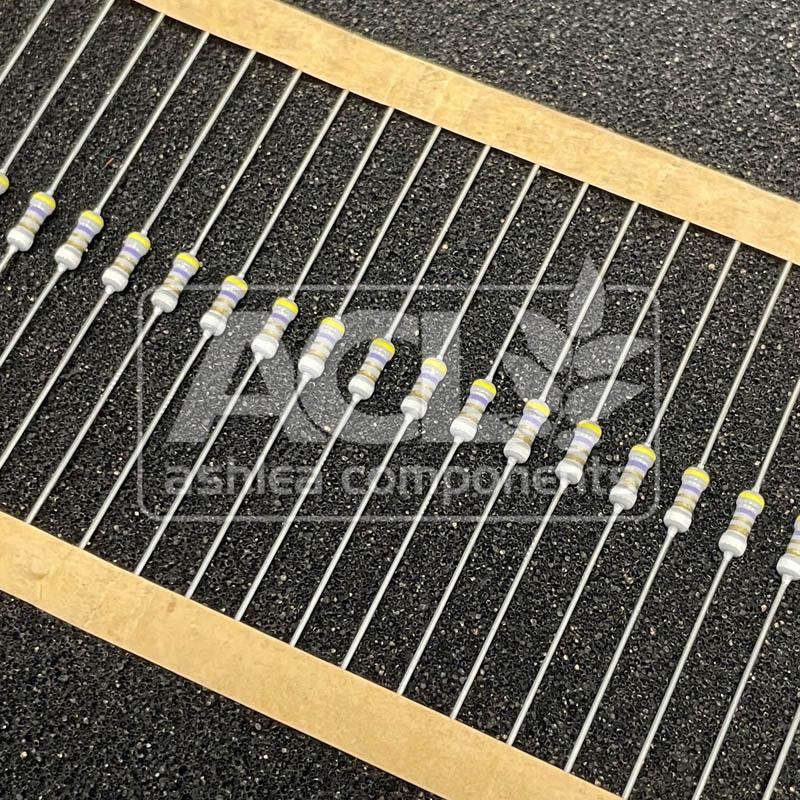
NFR25H0004708JR500
Resistor 4.7Ω, 0.5W, ±5%, 350V, NFR25H, Axial, Through Hole


